Combining Like Terms Worksheets
Printable worksheets for mastering combining like terms — from simple one-variable expressions to two variables, squared terms and expressions that need the distributive property first. Every sheet has 20 problems and a full answer key.
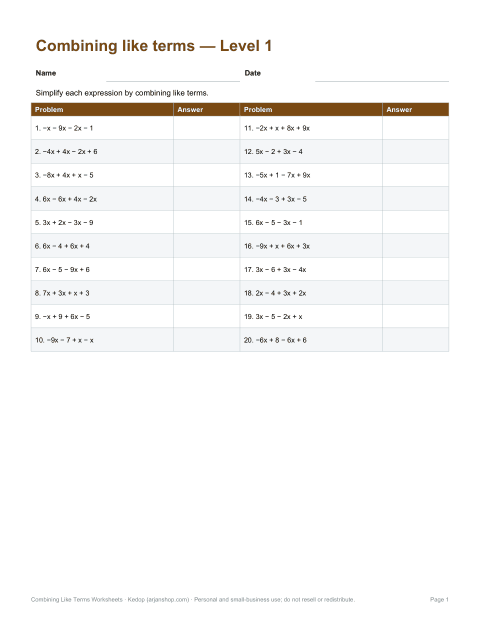
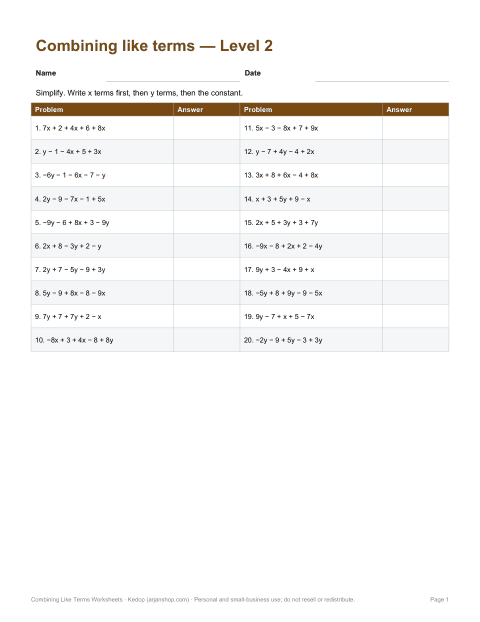
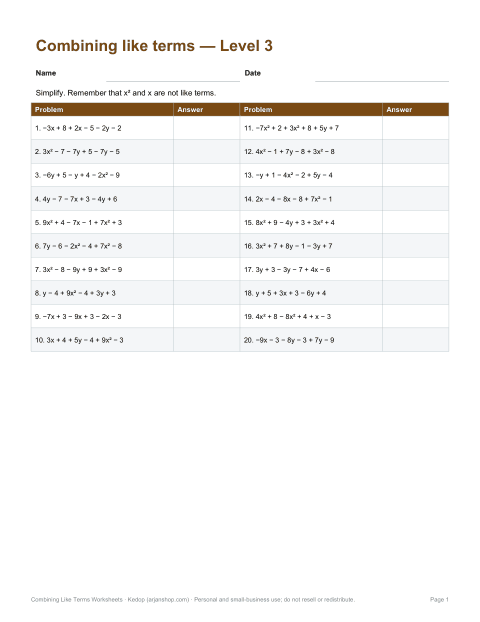
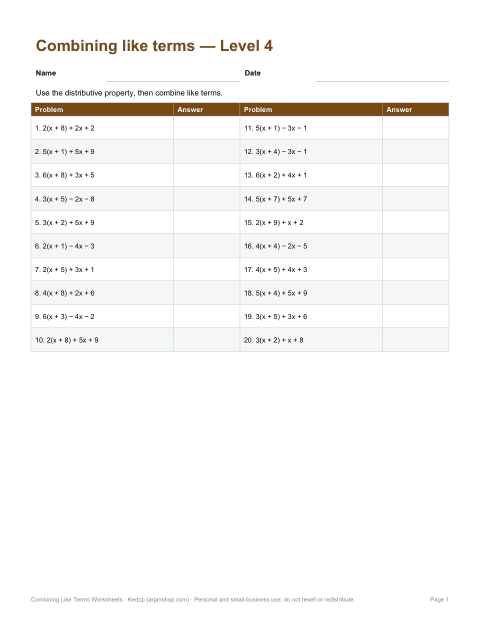
Combining Like Terms Worksheets
Four levels of printable combining like terms worksheets with answer keys, a step-by-step guide and editable Word versions.
- Level 1: one variable (PDF, DOCX)
- Level 2: two variables (PDF, DOCX)
- Level 3: squared terms (PDF, DOCX)
- Level 4: distribute first (PDF, DOCX)
- Step-by-step guide (PDF, DOCX)
Formats: PDF, DOCX. Instant download after payment (link valid 72 hours, up to 5 downloads). AI-assisted: the templates were drafted with AI help and reviewed and laid out by Kedop.
$5.00 USD, one-time
Secure card checkout by Stripe. Full refund within 7 days — see the refund policy and license.
What combining like terms means
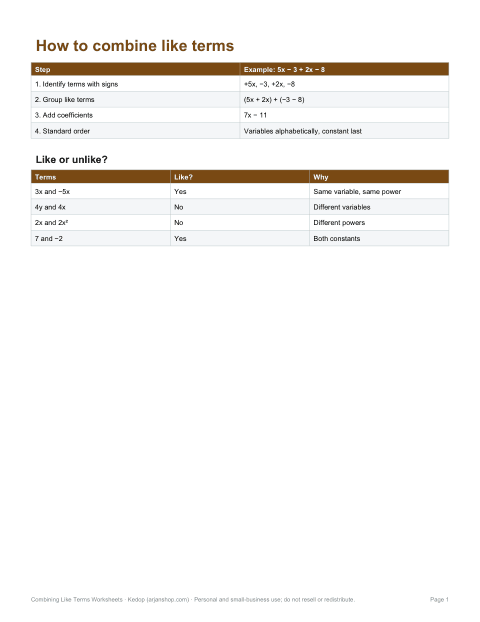
Like terms have the same variable raised to the same power: 3x and −5x are like terms, 4y and 7y are like terms, but 3x and 3x² are not, and neither are 2x and 2y. Constants such as 7 and −2 are like terms with each other. To simplify an expression, add or subtract the coefficients of like terms and keep the variable part the same: 3x + 5 − 2x + 7 becomes (3 − 2)x + (5 + 7) = x + 12.
What is in the pack
- Level 1: one variable — expressions with x terms and constants.
- Level 2: two variables — x, y and constants mixed together.
- Level 3: squared terms — x², x, y and constants, the classic place where students confuse unlike terms.
- Level 4: distributive property first — expressions such as 4(x + 3) − 2x + 5.
- Answer keys for every sheet, with simplified answers in standard order.
- Step-by-step guide — a one-page reference with worked examples for students.
- Editable Word versions so teachers can change problems or combine levels.
Step-by-step method
- Identify the terms, including their signs: in 5x − 3 + 2x − 8, the terms are +5x, −3, +2x and −8.
- Group like terms together: (5x + 2x) + (−3 − 8).
- Add the coefficients: 7x − 11.
- Write the answer with variable terms first in alphabetical order and the constant last.
A helpful habit is to underline, circle or colour-code each type of term before combining, and to treat the sign in front of a term as part of it.
Common mistakes
- Combining unlike terms, such as 3x + 2x² = 5x³.
- Dropping the negative sign: 7 − 3x + 2x should be 7 − x, not 7 − 5x.
- Forgetting that x means 1x.
- Distributing to only the first term: 3(x + 4) is 3x + 12, not 3x + 4.
- Changing the variable part when adding: 4x + 3x is 7x, not 7x².
How to use the worksheets
Start with Level 1 as a warm-up, then move on once students score around 80% or better. Levels 2 and 3 work well as practice after introducing multiple variables and exponents. Level 4 links combining like terms with the distributive property, which leads into solving multi-step equations. Each sheet has 20 problems in two columns with space for working; answer keys are on the following page so you can print them separately.
Who it is for
Middle school and early high school algebra students (typically grades 6–9), tutors, homeschooling families and adult learners reviewing algebra for exams. The problems align with standard pre-algebra and Algebra 1 objectives for simplifying expressions.
Worked examples by level
| Level | Expression | Simplified |
|---|---|---|
| 1 | 6x − 4 + 2x + 9 | 8x + 5 |
| 2 | 3x + 2y − x + 5y − 4 | 2x + 7y − 4 |
| 3 | 4x² + 3x − x² + 2x + 1 | 3x² + 5x + 1 |
| 4 | 3(x + 4) − 2x + 5 | x + 17 |
In level 4, distribute first — 3(x + 4) becomes 3x + 12 — and then combine: 3x − 2x = x and 12 + 5 = 17. Showing each step on the page is the easiest way to catch sign errors.
Teaching tips
Algebra tiles or simple drawings help students see why only like terms combine: three x-rectangles and two unit squares cannot merge into five of anything. Colour-coding works well on paper — circle x terms in one colour, y terms in another and constants in a third before adding. Ask students to substitute a value for x into the original and simplified expressions to check that both give the same result; this habit catches most mistakes and builds understanding of what “equivalent expressions” means.
Formats
Every worksheet and key is a print-ready PDF (US Letter, printable on A4) and an editable DOCX. Problems use clear notation with proper minus signs and superscripts.
Frequently asked questions
What grade learns combining like terms?
Usually grades 6–8 in pre-algebra, with more complex expressions in Algebra 1.
Are answer keys included?
Yes, every worksheet has a matching answer key.
Can I edit the problems?
Yes, the Word versions are fully editable.
How many problems are there?
Each of the four levels has a 20-problem sheet with key, plus a guide with worked examples.
Was AI used to create the worksheets?
The problems were generated by a script and checked; the guide was drafted with AI assistance and reviewed by Kedop.